Terracotta & Sage Green Kitchen: 10 Stunning Ideas!
A Terracotta & Sage Green Kitchen can be practical and beautiful without feeling cold, predictable, or overly decorated. One of the most appealing ways to achieve this balance is to combine sage green with terracotta. Sage green brings a soft, botanical quality to cabinetry and walls, while terracotta introduces the warmth of natural clay, sun-baked earth, and traditional Mediterranean architecture.
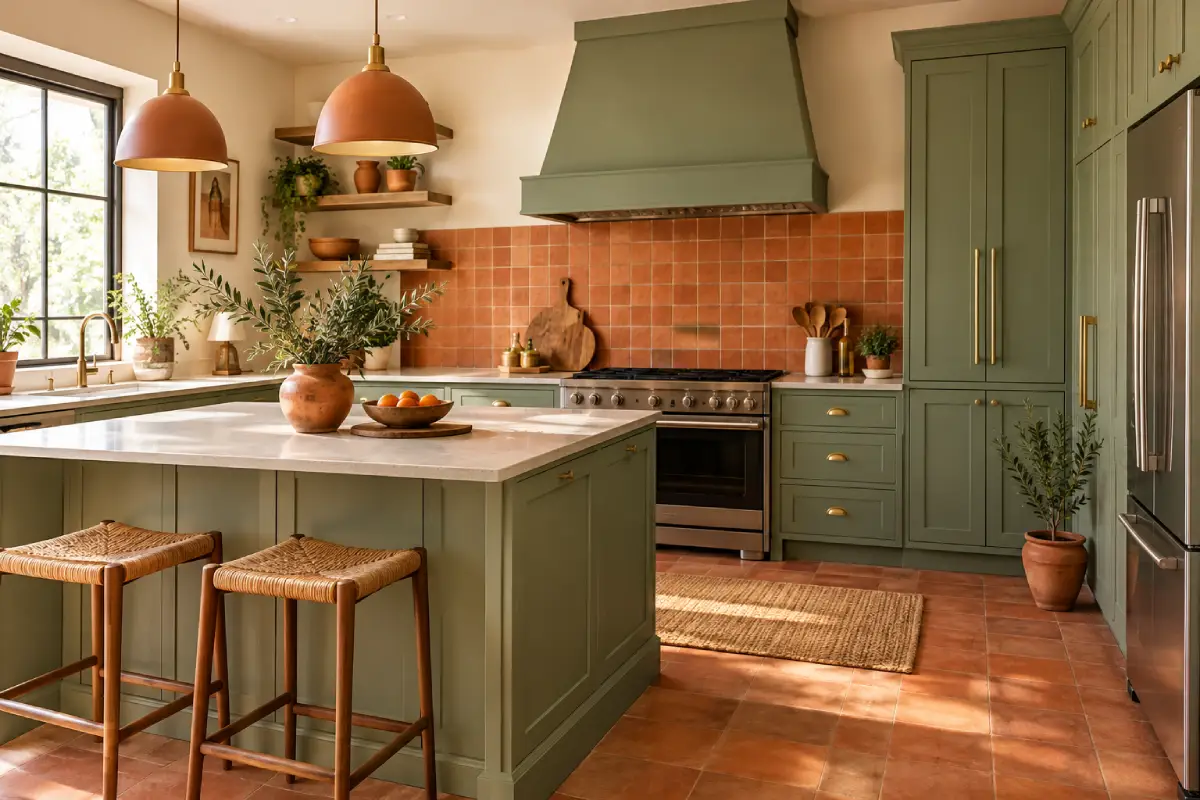
A Terracotta & Sage Green Kitchen can feel rustic, contemporary, elegant, or relaxed depending on the materials, proportions, and finishes you choose. Imagine muted green cabinets paired with handmade clay tiles, a warm white countertop, natural oak shelves, and understated brass hardware. Each element contributes something different, yet the overall palette feels connected.
However, successful kitchen design involves more than choosing two attractive colors. The undertones must complement each other, the tile sizes should suit the room, and the countertop must work with both the cabinetry and backsplash. Lighting, storage, and circulation also influence whether the finished space feels inviting or awkward.
The good news is that this color combination works in kitchens of many sizes and budgets. You can introduce terracotta through flooring, a backsplash, decorative ceramics, or even a few carefully selected accessories. Sage green can appear on all the cabinetry, a kitchen island, or a smaller section of wall.
In this guide, you will discover ten practical design ideas, learn how to select complementary materials, explore layout considerations, and understand which common mistakes are worth avoiding. Whether you are planning a complete renovation or refreshing an existing kitchen, these suggestions will help you create a space that looks considered and works beautifully every day.
Table of Contents
1. How to Balance Earthy Tones for a Warm, Harmonious Terracotta & Sage Green Kitchen
The foundation of a successful earthy kitchen is balance. Sage green and terracotta have distinct visual personalities: green tends to feel calm and understated, while terracotta often draws attention because of its warm red, orange, or brown undertones.
Rather than giving both colors equal prominence, decide which one should establish the main visual impression.
Idea 1: Make Sage Green Your Main Color
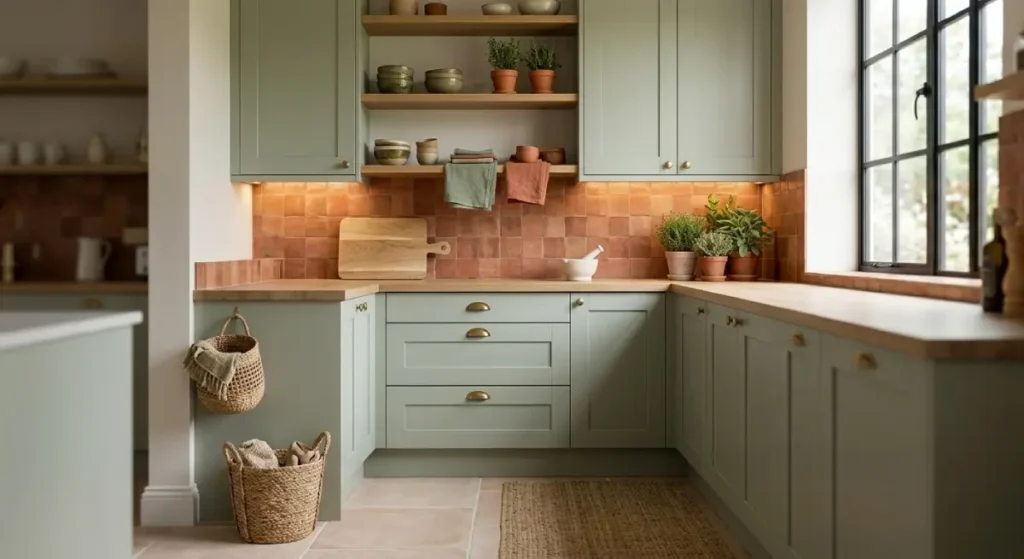
Sage green is an excellent choice for kitchen cabinetry because it introduces color without the intensity of brighter greens. Its muted appearance works well with natural materials and can adapt to several interior styles.
For a timeless look, consider sage green shaker cabinets, warm white walls, and a pale countertop. Terracotta can then appear in the backsplash, floor tiles, or smaller decorative details.
If your kitchen receives limited daylight, choose a lighter sage with a relatively soft undertone. Darker olive-leaning greens can look beautiful in bright rooms, but they may make a small or poorly lit kitchen feel heavier.
Before choosing a cabinet color, test a sample on the actual surface or view a large painted sample board in the room. Observe it in the morning, afternoon, and evening. Artificial lighting can change how green appears, so a color that looks neutral in a showroom may look noticeably yellow or gray at home.
Idea 2: Introduce Terracotta Where It Has the Greatest Impact
Terracotta does not need to cover every surface to make a statement. In fact, using it selectively often produces a more sophisticated result.
A backsplash behind the cooking area can establish a focal point. Terracotta floor tiles can provide a stronger architectural foundation, while pottery, planters, and textiles offer a flexible option for renters or homeowners working with a limited budget.
A useful starting point is the 60-30-10 color guideline: approximately 60% dominant color, 30% supporting color, and 10% accent color. This is a flexible design principle rather than a strict mathematical requirement.
For example, sage green cabinets, warm ivory walls, and a terracotta backsplash can feel balanced even when the actual surface proportions differ. The objective is to give the eye a clear visual hierarchy.
Idea 3: Use Warm Neutrals to Connect the Palette
Warm white, cream, sand, and natural wood help connect green and terracotta without introducing unnecessary contrast.
Oak is particularly versatile. Pale oak creates a light, contemporary atmosphere, while walnut or medium-toned timber adds depth. A warm white countertop can bridge the colors, allowing the cabinetry and tiles to remain the main features.
Pay attention to undertones. A pinkish terracotta may clash with a yellow-based sage, while a muted brown-red clay can complement it beautifully. Collect samples of your cabinets, countertop, backsplash, and flooring before purchasing large quantities.
Designer tip: Avoid choosing every material separately. Place all the samples together and evaluate the combination as one composition. This simple step can prevent expensive mistakes.
2. Beautiful Tile and Backsplash Combinations That Make a Statement
Tiles can give an earthy kitchen its distinctive character. Their color, shape, surface texture, and grout lines influence whether the room feels traditional, contemporary, or Mediterranean-inspired.
A successful tile choice should complement the cabinetry while meeting the practical requirements of the location.
Idea 4: Create a Focal Point with a Terracotta Backsplash
A terracotta backsplash introduces warmth directly beside sage green cabinets. Handmade-looking ceramic tiles are particularly attractive because slight variations in color and glaze create depth without requiring an elaborate pattern.
For a restrained look, consider square tiles, simple rectangles, or softly irregular glazed surfaces. If your cabinets have detailed shaker fronts, a straightforward tile pattern will usually provide enough visual interest.
You can install the backsplash between the countertop and upper cabinets or extend it higher behind a range hood to emphasize the cooking area.
Grout deserves equal consideration. Cream or warm beige grout creates a softer appearance, while contrasting grout makes the layout more prominent. Ask your tile supplier about suitable grout and cleaning products for the specific tile and installation conditions.
Remember to consider the cooking zone. Choose a backsplash material and installation system appropriate for the appliance, heat exposure, and local requirements.
Idea 5: Pair Sage Green Cabinets with Terracotta Flooring
A sage green kitchen with terracotta tiles on the floor creates a grounded, welcoming appearance. The cabinets provide a calm vertical element, while the warm floor anchors the space.
Traditional terracotta clay has a distinctive natural appearance, but it can be porous and may require appropriate sealing. Terracotta-look porcelain offers another option, often with lower absorption and simpler maintenance.
| Flooring material | Main advantage | Important consideration |
|---|---|---|
| Traditional terracotta | Authentic clay texture and natural variation | May need sealing and careful maintenance |
| Terracotta-look porcelain | Generally easy to clean | Check surface quality and slip resistance |
| Glazed ceramic | Wide range of colors and patterns | Confirm suitability for flooring |
| Natural stone | Distinctive texture and mineral variation | Maintenance depends on the stone |
Tile dimensions affect the overall impression. Larger tiles generally create fewer grout lines and can make a small room feel less busy. Smaller tiles may suit traditional kitchens but introduce more visual texture.
Always compare flooring samples against the cabinets and countertop. A tile that looks soft and neutral in a photograph may appear much more orange or red under your kitchen lighting.
Idea 6: Mix Patterns Without Overwhelming the Room
A kitchen already has several visual elements: cabinetry, appliances, flooring, countertops, and lighting. Introducing strong patterns everywhere can make the space feel disorganized.
If you choose a patterned backsplash, keep the countertop relatively understated. If the floor has a pronounced geometric arrangement, select simpler wall tiles.
Herringbone patterns add movement, while vertical rectangular tiles can draw the eye upward. Handmade square tiles provide an artisanal quality, and larger-format tiles create a more streamlined appearance.
Common mistake to avoid: Choosing the backsplash and floor independently. Both materials may look beautiful on their own but compete when installed together. Review all major finishes at the same time, and decide which surface should be the focal point.
3. Choosing the Perfect Countertops, Cabinet Finishes, and Hardware
Cabinetry and countertops occupy a substantial part of the kitchen, so their finishes have a major influence on the final result. The right combination should connect the green and terracotta elements while remaining durable enough for everyday use.
Idea 7: Select a Countertop That Complements Both Colors
Warm white quartz is a versatile choice because it creates a bright transition between green cabinets and clay-colored tiles. Subtle beige or gray veining can introduce interest without overpowering the palette.
Natural marble offers distinctive veining and an elegant appearance, but it can etch when exposed to acidic substances. Wood countertops create warmth, although they need appropriate care around sinks and wet preparation areas.
Granite and other natural stones provide individual patterns, while porcelain slabs can suit contemporary kitchens with streamlined finishes.
| Countertop option | Design effect | What to consider |
|---|---|---|
| Warm white quartz | Bright and versatile | Heat guidance and stain resistance |
| Marble | Elegant and distinctive | Etching and maintenance |
| Wood | Warm and organic | Water exposure and refinishing |
| Granite | Natural variation | Pattern density and sealing |
| Porcelain slab | Contemporary and streamlined | Fabrication and installation |
The best choice depends on how you cook, how much maintenance you are comfortable with, and the overall appearance you want.
Ask suppliers for physical samples and compare them against the actual cabinet and tile finishes. Even a small difference in undertone can change the balance of the entire room.
Idea 8: Choose Cabinet Finishes and Hardware with Care
Sage green works well with both traditional and modern cabinet styles. Shaker doors create a familiar, timeless look, while flat-front cabinets produce a cleaner, more contemporary result.
A matte or low-sheen finish often complements the natural character of terracotta, but performance varies between products. Ask about fingerprint resistance, cleaning requirements, and suitability for kitchen use before making a final choice.
Hardware adds another layer of detail.
Brushed brass introduces warmth, bronze creates a deeper traditional appearance, and brushed nickel offers a more understated contrast. Black handles can look striking against pale sage cabinetry, particularly when repeated in selected lighting or appliance details.
Choose hardware according to the scale of the cabinets. Long drawer pulls can suit broad drawers, while smaller knobs may be more appropriate for narrow doors. Check that handles do not interfere with adjacent walls or appliance doors.
A restrained palette of one main metal finish and a limited number of complementary materials usually feels more intentional than mixing several unrelated finishes.
Designer tip: If you are updating existing cabinets, investigate whether they are suitable for repainting before purchasing paint. Proper cleaning, surface preparation, compatible primer, and a suitable coating system are essential for a durable result.
4. Lighting, Natural Textures, and Accessories That Elevate Your Space
Lighting and accessories determine how a kitchen feels throughout the day. They can emphasize the texture of terracotta, soften the appearance of cabinetry, and make practical work areas more comfortable.
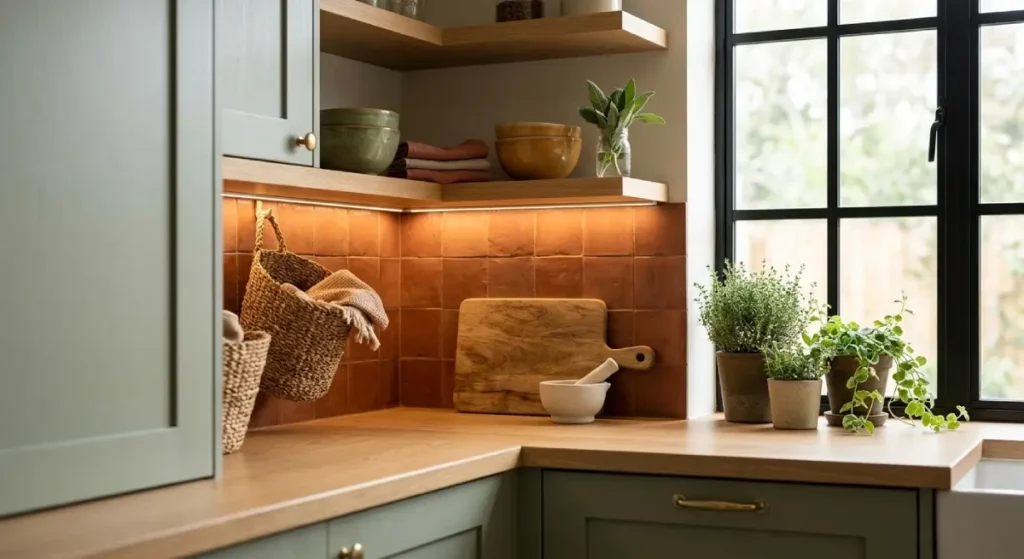
Idea 9: Layer Lighting for Function and Atmosphere
A well-planned kitchen uses several types of lighting rather than relying on a single ceiling fixture.
Ambient lighting provides general illumination. Task lighting illuminates work surfaces, while accent lighting draws attention to shelves, pottery, or an attractive backsplash.
Under-cabinet lighting is especially useful because upper cabinets can cast shadows across the countertop. Pendants can define an island or breakfast bar, while suitable ceiling fixtures provide overall illumination.
For a warm residential atmosphere, approximately 2700-3000 K is a useful starting point. A slightly more neutral range may suit some task areas. Color rendering matters as well, because it affects how accurately the green cabinets, clay tiles, and natural wood appear.
Always consider fixture placement and actual lighting performance rather than relying on color temperature alone.
Add Natural Materials for Depth
Oak shelves, ceramic bowls, linen curtains, woven baskets, and stone accessories can strengthen the connection between the color palette and natural materials.
However, texture should be introduced selectively. If your backsplash already has an irregular handmade surface, smooth cabinet fronts and a simple countertop can create a pleasing contrast.
Open shelves can display everyday plates, glasses, and a few decorative objects. Group items by color or material, vary their heights, and leave some empty space so the display does not appear crowded.
Keep frequently used work surfaces clear. Too many decorative objects reduce preparation space and create extra cleaning.
Plants can introduce another layer of green, but choose varieties suited to the available light and place them where they will not interfere with food preparation.
Textiles are an affordable way to reinforce the palette. A warm neutral runner, terracotta tea towels, or sage green seat cushions can update the kitchen without major renovation.
Common mistake to avoid: Matching every accessory to the cabinets and tiles. A few related colors create cohesion, but exact repetition everywhere can make the design feel artificial. Natural variation gives the room more personality.
5. Smart Layout and Styling Ideas for Small and Large Kitchens
The most beautiful Terracotta & Sage Green Kitchen still needs to function well. Storage, circulation, appliance placement, and preparation areas should be considered alongside decorative finishes.
Make a Small Kitchen Feel More Spacious
In a compact sage green and terracotta kitchen ideas, lighter sage cabinetry, warm white walls, and a pale countertop can help maintain brightness. Terracotta can appear in a backsplash or selected accessories rather than covering every available surface.
Choose tile patterns carefully. Large-format tiles may reduce the number of grout lines on the floor, while a simple backsplash can keep the room from feeling visually crowded.
Practical improvements are equally important. Use drawer organizers, vertical dividers, and pull-out storage to make cabinets more efficient. Keep frequently used appliances close to the areas where they are needed, and avoid allowing decorative accessories to occupy valuable preparation space.
Open shelving can work well in small kitchens, but it should not replace essential closed storage unless you genuinely have enough room for your everyday items.
Plan the Work Areas Before Choosing Decorative Details
Traditional kitchen planning often considers the relationship between the refrigerator, sink, and cooking area. This provides a useful starting point, but the best arrangement depends on the room’s dimensions and the number of people using it.
In a one-wall kitchen, organize storage, preparation, washing, and cooking in a practical sequence. In an L-shaped kitchen, ensure corner storage is accessible and appliance doors can open comfortably. In a U-shaped kitchen, consider the space between opposing cabinets.
As a general planning reference, residential walkways may start around 36 inches (91 cm), while active work aisles often benefit from approximately 42 inches (107 cm) or more. These are guidelines rather than universal code requirements. Local regulations, accessibility needs, appliance specifications, and the number of cooks may call for different dimensions.
For an island, consider its purpose before deciding its size. An island that provides preparation space and useful storage can be valuable, but one that leaves insufficient circulation space may make the kitchen less functional.
Style Large and Open-Plan Kitchens
Larger rooms can accommodate richer sage green cabinetry, deeper terracotta flooring, and more prominent statement surfaces. However, generous space does not remove the need for visual balance.
A contrasting island can establish a focal point, while oak stools and warm metal pendants connect the kitchen to the adjoining dining area.
In open-plan spaces, repeat one or two colors outside the kitchen. A terracotta vase on a dining table or sage green upholstery nearby can create continuity without making the entire home look identical.
For a Mediterranean-inspired interior, combine clay tiles, oak, pale stone, and simple hardware. For a contemporary kitchen, use flat-front cabinets, restrained patterns, and streamlined lighting. For a farmhouse look, consider shaker doors, handmade-looking tiles, and natural timber.
Refresh Your earthy green and terracotta kitchen decor on a Realistic Budget
A complete renovation is not always necessary. If the layout and cabinets remain in good condition, consider repainting suitable cabinet surfaces, replacing outdated handles, improving task lighting, or adding a new backsplash.
Before replacing flooring or countertops, assess whether the existing materials can be cleaned, repaired, or incorporated into the new palette.
Prioritize changes that improve daily use as well as appearance. Better lighting, functional storage, and durable work surfaces may offer more lasting value than decorative features that look attractive but do little to improve the kitchen.
Conclusion
A Terracotta & Sage Green Kitchen can feel welcoming, distinctive, and timeless when its colors and materials are chosen with care. Sage green establishes a calm foundation, terracotta adds warmth, and natural wood, pale stone, and thoughtful lighting connect the different elements.
Start by selecting the main cabinet color and one complementary terracotta surface. Compare samples in your own kitchen, consider the amount of daylight, and choose finishes suited to your everyday routine. Then refine the design through hardware, lighting, storage, and a few carefully selected accessories.
Whether you prefer a contemporary apartment kitchen or a relaxed Mediterranean-inspired space, the most successful design is one that combines visual character with practical decisions. You do not need to follow every trend or replace every surface. With a clear palette, appropriate materials, and attention to proportions, you can create a kitchen that feels personal, functions beautifully, and remains enjoyable for years to come.
FAQs – Terracotta & Sage Green Kitchen: 10 Stunning Ideas!
Is terracotta and sage green a good kitchen color combination?
Yes. Sage green provides a muted, natural backdrop, while terracotta introduces warmth and contrast. The combination works with modern, farmhouse, rustic, and Mediterranean-inspired designs.
What colors work best with sage green cabinets and terracotta tiles?
Warm white, cream, beige, oak, and pale stone are versatile options. Brushed brass and bronze introduce warmth, while black hardware creates stronger contrast.
Can terracotta tiles work in a small kitchen?
Yes. Choose a tile pattern that suits the room’s proportions and avoid combining several strong patterns. Lighter cabinetry, pale countertops, and warm neutral walls can help maintain an open appearance.
Which countertop is best for this color scheme?
Warm white quartz is a versatile starting point. Wood offers an organic appearance, while granite and marble provide distinctive natural patterns. Compare actual samples before making your decision.
How can I introduce terracotta kitchen floor with sage green cabinets without renovating?
Use ceramic accessories, planters, tea towels, a small backsplash update, or other removable decorative elements. These changes allow you to test the palette before committing to a larger project.
Are terracotta tiles difficult to maintain?
Maintenance depends on the material. Traditional clay may require sealing, while porcelain alternatives generally need less maintenance. Follow the manufacturer’s cleaning and care recommendations.